Horned Animals Wildlife Photography Winner

Packy Savvenas - Photography Award - Best Horned Animals
35 Awards · Horned Animals
October 2021
Wildlife Photography

Horned Animals Wildlife Photography Winner

For the second consecutive year, recognized among the Top 35 Wildlife Photographers in the United States by 35AWARDS.

October 2021 Grand Teton NP, Wyoming Packy Savvenas
3 min read

By the time I reached him, I had already crossed enough cold water to stop feeling my feet.

That is usually how these things go.

The frame people see at the end looks clean. Effortless, even. A bull moose in full velvet, standing in evening light with the sun striking him from behind, every edge of those antlers lit like they were carrying their own fire.

What the picture does not show is the way in.

The river crossings. The wet ground. The long push through the forest. The places where the trail gives up and you keep going anyway because something in you says he is still farther in. Still ahead. Still worth it.

That evening, I was after moose the way I always am when summer starts leaning toward change. Quietly. Patiently. Looking for one clean moment in a place that almost never gives you one for free.

Then the woods opened just enough.

And there he was.

A bull in beautiful velvet, heavy and calm, moving through the trees like he had all the time in the world. The sunlight was dropping behind him, slipping through the forest at the perfect angle, catching the velvet and setting it on fire. Not bright fire. Soft fire. The kind that lasts a minute if you are lucky and disappears if you move wrong.

I did not need to tell myself to slow down. The animal did that for me.

Everything about a moose like that makes you smaller. The body. The stillness. The sense that you are looking at something ancient and unfinished at the same time. Velvet always does that to me. It makes a bull look powerful, but not yet sharpened. Like he is still becoming what he will be.

I raised the camera and took what the evening gave me.

A few steps. A pause. Light through the paddles. A turn of the head. Then the forest started taking him back.

That was it.

No drama. No second chance. Just one of those moments that feels bigger while it is happening, even before you know what it will become.

Later, I found out that image was selected in the Horned Animals competition through 35AWARDS, one of the largest photography competitions in the world. Three of my images were recognized there, and I will be sharing one from that evening, the one that still feels like it came out of the trees carrying its own weather.

This year, more than 1,610 professional and amateur photographers from 173 countries entered the competition, with over 3,742 photos submitted.

I am grateful for the recognition, of course.

But what stays with me is not the email.

It is the river.
The forest.
The last light.
And that bull, standing there in velvet like the evening had been waiting on him the whole time.

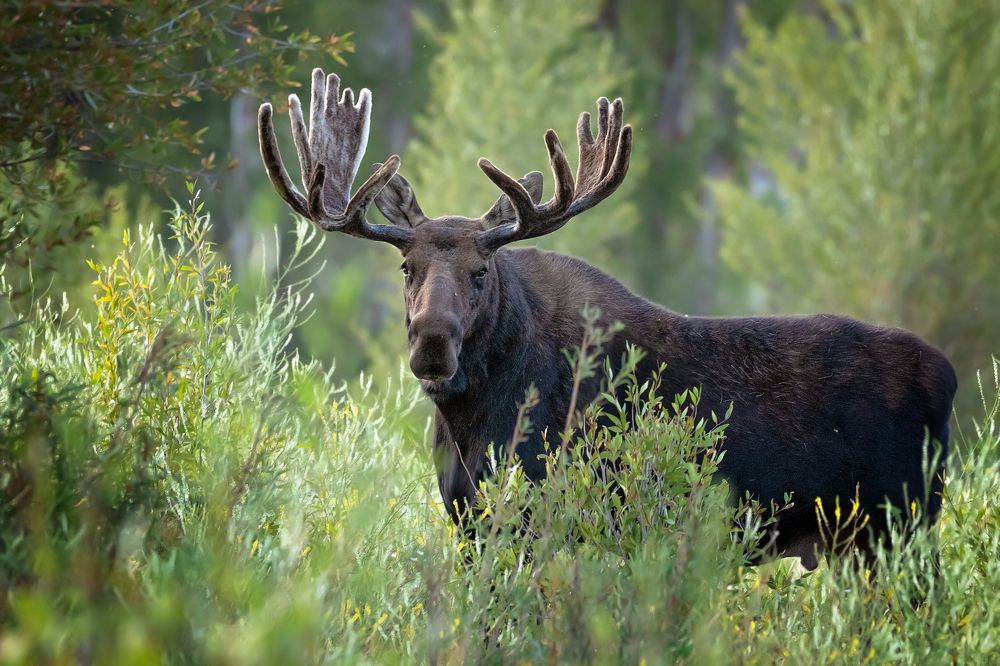
Photo Details

Subject

Bull Moose

Alces alces shirasi

Location

Grand Teton NP

Wyoming, USA

Season

Pre-Rut

September 2021

Light

Golden Hour

Sunset ambient

Recognition
2021

7th Year — Top 35 USA

35 Awards · Top 35 USA Photographers

2021

Horned Animals Winner

Wildlife Photography Division

2020

6th Year — Top 35 USA

35 Awards (consecutive recognition)

Packy Savvenas portrait

Packy Savvenas

Greek Mountain Man

Award-winning wildlife photographer based in the Greater Yellowstone Ecosystem. 2× Top 35 USA.

Full Bio

Wildlife Photography Cheat Sheet

Capture Wildlife at Its Best: ISO, Aperture, and Shutter Speed – Wildlife Photography Cheat Sheet Giveaway

Are you tired of missing the perfect shot of that stunning bird or majestic animal? Do you want to take your wildlife photography to the next level? Then it’s time to master the trio: ISO, aperture, and shutter speed. These three settings are the key to capturing stunning images of wildlife with the right exposure and creative control.

But with so many technical terms and settings, it can be overwhelming to know where to start. That’s why we’ve put together a comprehensive wildlife photography cheat sheet that will make understanding ISO, aperture, and shutter speed a breeze.

Here’s a sneak peek of what you’ll find in this cheat sheet:

ISO:

  • What it is: ISO measures the sensitivity of your camera’s sensor to light.
  • Best practices for wildlife photography: Keep ISO as low as possible to reduce noise (graininess) in your images, especially when shooting in low light conditions.
  • How to adjust:
    1. Locate the ISO setting on your camera. It may be in the menu or accessible through a physical button or dial.
    2. Adjust ISO in increments, such as 100, 200, 400, 800, and so on.
    3. Start at the lowest ISO value and increase as needed.
    4. Take test shots and review them to see how the change in ISO affects the exposure.
    5. Repeat this process until you achieve the desired exposure.

Aperture:

  • What it is: Aperture refers to the size of the opening in the lens that lets light into the camera.
  • Best practices for wildlife photography: Use a wide aperture (low f-number) to isolate your subject from the background, which can help reduce distractions and make your subject stand out.
  • How to adjust:
    1. Locate the aperture setting on your camera. It may be in the menu or accessible through a physical button or dial.
    2. Adjust aperture by changing the f-number, such as f/1.8, f/2.8, f/4, and so on.
    3. Take test shots and review them to see how the change in aperture affects the depth of field.
    4. Repeat this process until you achieve the desired depth of field.

Shutter Speed:

  • What it is: Shutter speed refers to the amount of time that the shutter remains open to allow light into the camera.
  • Best practices for wildlife photography: Use a fast shutter speed to freeze action, especially when shooting moving wildlife, and a slower shutter speed to capture motion blur for creative effect.
  • How to adjust:
    1. Locate the shutter speed setting on your camera. It may be in the menu or accessible through a physical button or dial.
    2. Adjust shutter speed in fractions of a second, such as 1/60, 1/125, 1/250, and so on.
    3. Take test shots and review them to see how the change in shutter speed affects motion.
    4. Repeat this process until you achieve the desired motion effect.

With this cheat sheet in hand, you’ll be able to take control of your camera and capture stunning wildlife photos with ease. Don’t miss out on this opportunity to improve your photography skills and take your wildlife photography to the next level. Download your free wildlife photography cheat sheet today and start capturing wildlife at its best!

And here’s a visual representation of the information, to help you better understand the concepts: